
en
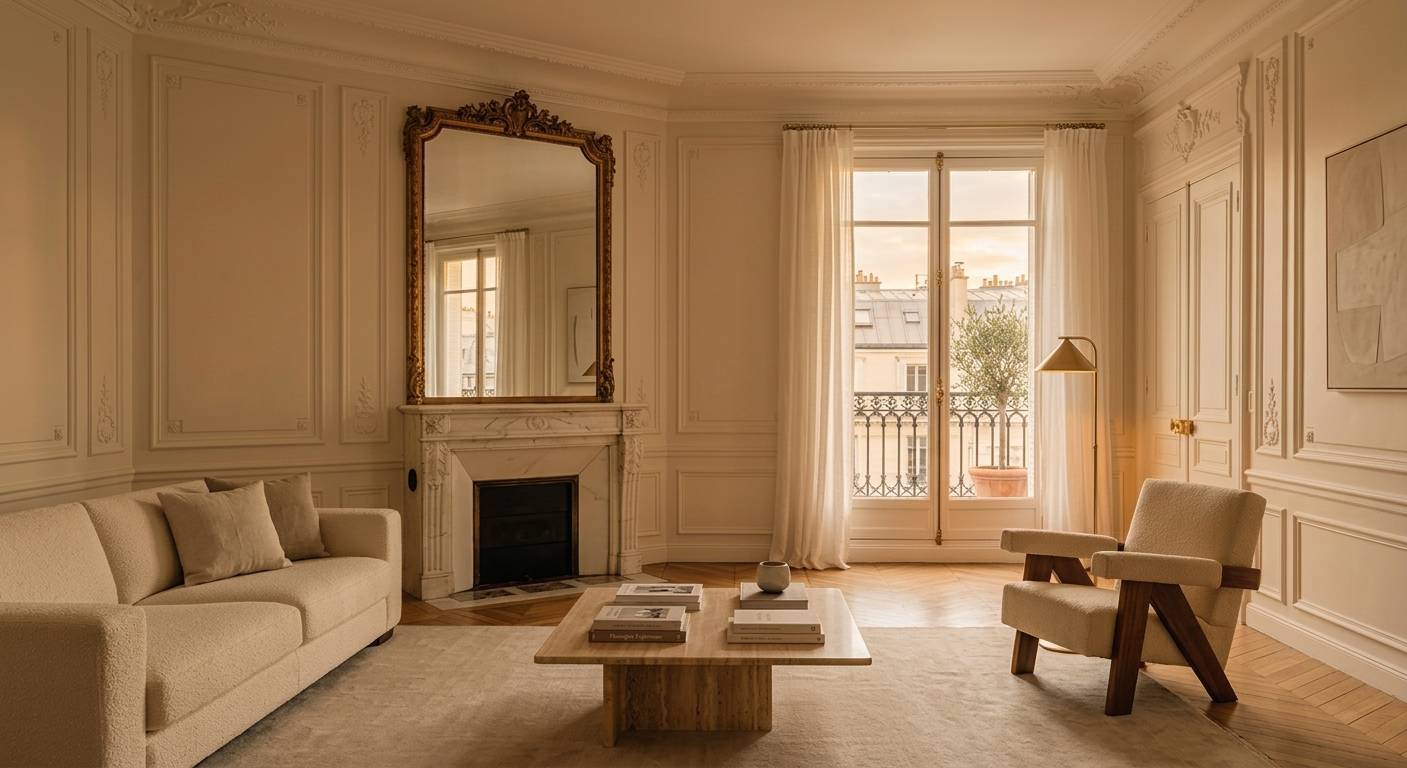
The ECB's 25-basis-point rate hike changes the financial environment for the autumn. What it means for Paris luxury real estate, buyers, sellers and the 2027 DPE reform.
On September 10, 2026, the European Central Bank raised all three of its key interest rates by 25 basis points. The decision comes as property financing conditions had already tightened slightly during the summer, while the Paris market had remained broadly stable in the spring.
For the luxury real estate market, the impact goes beyond the monthly mortgage payment. It also concerns buyers' financial strength, transactions dependent on a resale, the opportunity cost of capital and banks' perception of risk.
From September 16, 2026, the deposit facility rate will rise to 2.50%, the main refinancing operations rate to 2.65% and the marginal lending facility rate to 2.90%.
The ECB justifies the increase by inflationary pressures linked to the conflict in the Middle East and energy. It now forecasts average inflation of 3.0% in 2026, 2.5% in 2027 and 2.1% in 2028. Its growth forecasts stand at 0.9%, 1.4% and 1.5% respectively over these three years. It highlights upside risks to inflation and downside risks to economic activity. ECB monetary policy decision of September 10, 2026
Euro area annual inflation is estimated at 3.3% in August, compared with 2.9% in July. This figure remains provisional until the final publication on September 17. The increase is mainly driven by energy, whose prices rose by 14.3% year-on-year. Excluding energy, food, alcohol and tobacco, inflation stands at 2.4%. Eurostat flash estimate for August 2026
The ECB has provided no predetermined path for its next decisions. It will continue to decide meeting by meeting, based on inflation, economic data and the transmission of its monetary policy. Any precise prediction of another rate increase or a rapid rate cut would therefore remain speculative. ECB monetary policy statement
In France, the average rate on new housing loans excluding renegotiations reached 3.30% in July, compared with 3.27% in June. This figure excludes fees and insurance. Seasonally adjusted monthly production fell from €13.2 billion to €11 billion, while remaining within the fluctuation range observed since the end of 2024. Fixed-rate loans accounted for 99.4% of production. Banque de France, loans to individuals, July 2026
As of September 10, applications handled by CAFPI showed average rates in Île-de-France of 3.23% over 15 years, 3.47% over 20 years and 3.52% over 25 years, excluding insurance. At national level, the best applications observed obtained 3.10% over 20 years and 3.25% over 25 years. These commercial references describe financing actually negotiated by the broker; they are not conditions available to every borrower. CAFPI rate report, September 2026
France's 10-year Treasury benchmark, the TEC 10, stood at 4.32% on September 10, compared with 4.19% on September 1. Its movement contributes to banks' refinancing costs, alongside other factors: deposit costs, commercial policy, competition, borrower risk and capital requirements. The pass-through to mortgage rates therefore remains gradual and varies from one institution to another. Agence France Trésor, TEC 10
The following simulation assumes a fixed-rate, amortising loan over twenty years at 3.47%, corresponding to the Île-de-France average published by CAFPI on September 10.
| Borrowed capital | Monthly payment at 3.47% | At 3.57%: impact | At 3.67%: impact |
|---|---|---|---|
| €500,000 | €2,892 | €2,918, or +€26/month and approximately +€6,200 over 20 years | €2,944, or +€52/month and approximately +€12,400 over 20 years |
| €1,000,000 | €5,784 | €5,836, or +€51/month and approximately +€12,300 over 20 years | €5,887, or +€103/month and approximately +€24,800 over 20 years |
| €2,000,000 | €11,568 | €11,671, or +€103/month and approximately +€24,700 over 20 years | €11,775, or +€206/month and approximately +€49,500 over 20 years |
Calculations exclude borrower insurance, fees, guarantees and any potential early repayment costs. Additional amounts assume that the loan is held for twenty years.
These differences remain limited relative to the total price of some luxury acquisitions. They can nevertheless become decisive when financing is already close to the debt limit, when the buyer retains another loan or when a transaction depends on a bridging loan.
Between March and May 2026, 29,370 sales of existing homes were recorded in Île-de-France, the same volume as during the same period in 2025 and 15% higher than two years earlier. In Paris, the number of sales fell by 2% year-on-year.
The median price of Paris apartments reached €9,520/m² in May 2026, up 0.1% over twelve months. This was the latest official monthly release available from the Notaires du Grand Paris as of September 10. Notaires du Grand Paris, March-May 2026 market report
This Paris average does not fully describe family apartments and luxury properties. At a comparable address, floor level, natural light, layout, views, quality of renovation, building amenities and energy performance can create significant differences.
The luxury market has three levels of sensitivity to credit conditions:
Rare properties, correctly priced and ready to move into, benefit from demand that generally has a high level of equity. Their direct sensitivity to interest rates is lower.
Family apartments financed partly through a resale or significant borrowing are more exposed to banking delays, bridging loans and changes in borrowing capacity.
Properties requiring works, with a restrictive layout or poor energy performance, must absorb the renovation budget, its uncertainty and the cost of financing simultaneously. Their asking price therefore becomes decisive.
International buyers or those with substantial liquidity remain less dependent on French mortgage credit. Their decision nevertheless takes into account the return on risk-free investments, taxation, exchange rates and the opportunity cost of tying up capital. Rising bond yields therefore also influence cash purchases.
The coefficient used to convert final electricity consumption into primary energy in the DPE calculation will fall from 1.9 to 1.7 on January 1, 2027. This change should improve the rating of many electrically heated homes. No property will see its rating deteriorate solely because of the reform. French Ministry for Ecological Transition, decree published August 31, 2026
An improvement of one energy class will be possible for some properties; two classes may be gained in certain cases, mainly for small properties. The effect will not be systematic.
DPE assessments carried out before January 1, 2027 will retain their validity period. When a better rating results from the new calculation, an updated certificate may be obtained free of charge from the Ademe DPE-Audit Observatory, without a new visit from the assessor. Service-Public, new DPE calculation
This change calls for several precautions:
For some Paris apartments heated with electricity, particularly small properties, the reform may change how the property is perceived and its potential market. This impact must be assessed on a property-by-property basis.
These assumptions are intended to help prepare transactions; they are not forecasts.
Limited transmission. Competition between banks and the quality of certain borrower profiles make it possible to absorb part of the increase in financing costs. The best conditions remain concentrated among applications with a substantial down payment, regular income, remaining savings and low debt.
Gradual transmission. Rate schedules increase by 10 to 20 basis points. The effect remains moderate on monthly payments, but reduces borrowing capacity for households already close to their limits and weakens certain transaction chains.
More lasting pressure. Persistent energy inflation and high bond yields maintain banking selectivity. Properties dependent on substantial financing, a bridging loan or a renovation budget may then experience longer marketing periods and more demanding negotiations.
A valuation should take into account the property's intrinsic quality, comparable transactions, the likely buyer profile and their financing method. In a selective market, a consistent asking price from the outset helps preserve the attention of qualified buyers.
Preparing the technical file, DPE and co-ownership documents also helps shorten the analysis phase and limit late-stage reservations.
Recent bank approval provides greater security than a borrowing capacity calculated several months earlier. For substantial financing, the nominal rate, insurance, guarantee, repayment flexibility and amount of liquidity retained after the acquisition should be assessed separately.
A variation of a few basis points should be considered within the overall economics of the project: negotiated price, works, taxation, expected holding period and the property's investment quality.
Financial qualification should take place at the beginning of the search or before an offer is considered: actual available equity, financing needs, property to be sold, potential bridging loan, agreement in principle and banking timetable.
Rate data should always be accompanied by its date, term and scope. The ECB's September 10 decision reinforces this discipline, without making it possible to mechanically infer the next movement in bank rate schedules.
The ECB's 25-basis-point increase changes the financial environment for the autumn. Its impact on each acquisition will depend on the level of equity, the borrower's banking profile, the loan term and the structure of the transaction.
In Paris, the latest notarial data still show broadly stable average prices and slightly less activity than a year earlier. In the luxury segment, the hierarchy between properties should continue to depend above all on location, quality, rarity, condition and the accuracy of the asking price. Financing management and anticipation of the new DPE are becoming two additional components of a well-prepared transaction.
 | Author of the article Hugues de Poulpiquet Fairway Luxury Real Estate · Real Estate Market Trained as a lawyer and founder of Fairway Luxury Real Estate, Hugues de Poulpiquet writes Fairway's market insights dedicated to the Paris real estate market, sales strategies and the valuation of high-end residential properties. |
Fairway Luxury Real Estate
This site is protected by reCAPTCHA and the Google Privacy Policy and Terms of Service apply.