en
en
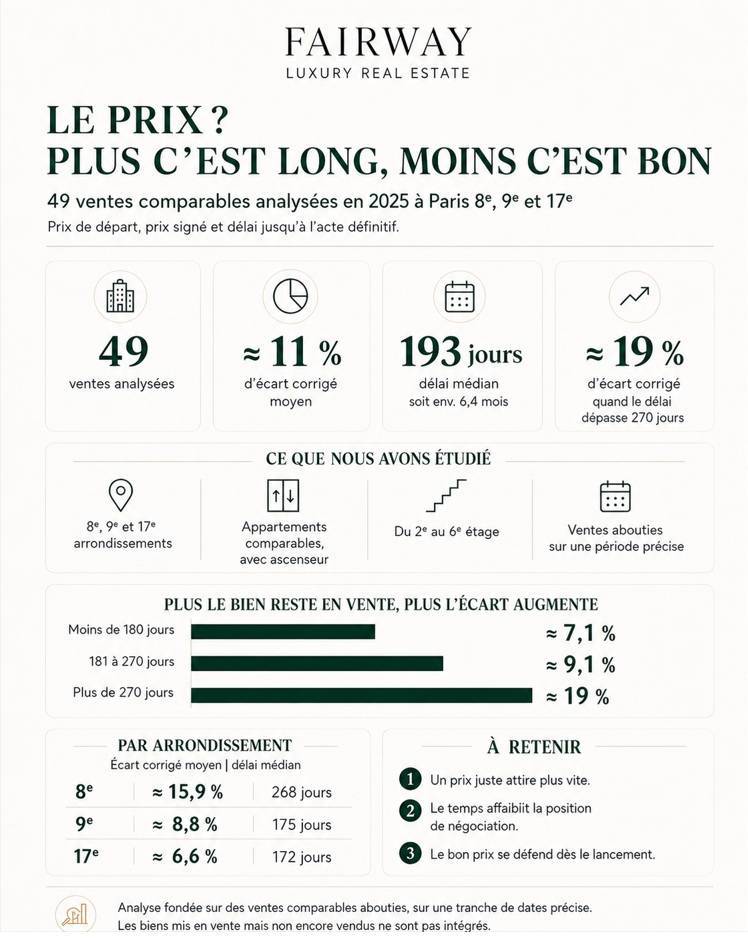
What 38 comparable apartment sales in Paris reveal about the gap between the initial asking price, the price recorded in the final deed and the actual time to sell.
Together with Andrea Mangen, Fairway Luxury Real Estate analysed 38 comparable apartment sales in Paris, in the 8th, 9th and 17th arrondissements, around areas we monitor closely: Hoche, Général Foy and Saint-Georges.
The comparison focuses on 2 very concrete data points: the initial asking price and the price actually recorded in the final deed.
We also examined the period between the property being placed on the market with an agency and the final deed. This is often the factor sellers underestimate. Price matters, of course. But the time spent on the market significantly changes how buyers perceive the property.
Across this sample, the actual gap observed is around 10%.
And when the period exceeds 270 days, the final adjusted gap reaches approximately 15.2%.
The analysis is based on 38 sales of comparable apartments located in the 8th, 9th and 17th arrondissements of Paris.
The areas studied are concentrated around 3 zones:
The properties studied are apartments with comparable characteristics: consistent surface areas, middle or upper floors, a lift, locations within tightly defined areas and a consistent sales period.
The aim is not to produce a general average for the whole of Paris. An average that is too broad combines properties that are not truly comparable. An apartment on avenue Hoche, rue de Courcelles, rue de Monceau, rue du Général Foy, rue Blanche or rue Saint-Lazare is not valued solely on the basis of its surface area.
In Paris, value depends on a combination of criteria: the exact address, floor, lift, light, layout, condition, building, co-ownership, works, energy performance rating, service charges and buyer perception.
The first figure to remember is the gap between the initial asking price and the price actually recorded in the final deed.
Across the 38 sales studied, the gross gap is 11.8%.
This figure must nevertheless be adjusted with caution, because the initial asking price may include agency fees, while the sale price shown in property transaction databases is not always perfectly comparable.
To remain cautious, we applied a partial adjustment for fees. After adjustment, the actual gap is around 10% to 10.2%.
This figure matters to a seller.
A property launched at €1,500,000 does not automatically end up at €1,350,000. Every apartment has its qualities, its drawbacks and its own market. But within this sample, the gap observed between the initial asking price and the final sale price is around 10%.
This means that an overly flattering initial asking price may create a sense of comfort at first, before leading to a much stronger negotiation a few months later.
The second figure to remember is the timeframe.
Across the sample analysed, the median period between the property being placed on the market with an agency and the final deed is 198 days, or approximately 6.5 months.
This period includes several stages:
This is a very concrete consideration for an owner. A sale launched in January may result in the funds being received in July or August, even when the transaction is progressing normally.
It is therefore important to distinguish between 2 things: the time required to find a buyer and the full period through to the final deed. An apartment may attract market interest quickly, but completion of the sale always requires a legal and notarial period.
The most telling finding concerns the effect of time.
When the sale takes place within less than 180 days, the adjusted gap remains around 6.5% to 7.0%.
Between 181 and 270 days, the gap rises to around 9.7%.
Beyond 270 days, it reaches approximately 15.2%.
The time spent online then becomes a point of negotiation.
We regularly see this in practice. A property launched at too high a price attracts fewer qualified viewings. Active buyers spot it, save it, compare it and then wait. When they return several weeks or several months later, their view of the price is often more severe.
At that stage, the property is no longer perceived as new to the market. It becomes a property whose initial price the market has not validated.
This is an important shift. The discussion is no longer only about the qualities of the apartment. It is also about its marketing history.
Many sellers believe that a high initial asking price allows them to preserve room for negotiation.
This is sometimes true, but only if the price remains defensible.
When a price is too far removed from buyer perception, it can produce the opposite effect:
A property that has been exposed for too long is not negotiated in the same way as a newly launched property.
The first few weeks are often the most important. The most active buyers already know the market. They have viewed several properties. They compare surface areas, floors, buildings, service charges, works, energy performance ratings and competing listings.
If the price is consistent, they arrange a viewing. If the price appears too high, they wait.
In Paris, particularly for family or high-end apartments, buyers no longer look only at the price per square metre.
They think in terms of total cost.
They add together:
It is often through this overall assessment that the gap between the price hoped for by the seller and the price that can genuinely be defended becomes apparent.
An apartment may be located at a very good address but still suffer a discount if the layout is difficult, the light is average, the works are extensive, the building is less elegant or the energy performance rating causes concern.
Conversely, a property may exceed local averages when everything is consistent: address, floor, lift, views, volumes, layout, renovation, quietness and rarity.
The value of this sample is also micro-local.
Around Hoche and Faubourg Saint-Honoré, the market remains highly sensitive to the quality of the address and the standing of the building. Buyers accept high price levels when the property justifies its positioning: reception rooms, floor, volumes, quietness, light, views, condition and common areas.
Around Général Foy, Europe and Saint-Augustin, the analysis is more family-oriented and patrimonial. Buyers look at the consistency between surface area, layout, transport, schools, building, level of works and proximity to neighbouring districts such as Miromesnil, Villiers or Monceau.
Around Saint-Georges and Nouvelle Athènes, value depends greatly on the charm of the neighbourhood, period buildings, local life, shops, schools and the quality of the street. But the differences can be significant depending on noise, exposure, floor, layout and overall condition.
These 3 areas clearly show why an arrondissement-wide average is not enough. The price must be built from precise comparables, but also from an on-the-ground understanding of the market.
The Paris market does not penalise expensive properties. It penalises properties whose price is not understood.
An ambitious price can be defended when it is based on solid arguments: a rare address, an attractive building, a sought-after floor, an efficient layout, light, quietness, a high-quality renovation, no major works or strong heritage value.
By contrast, a flattering but weakly defensible price can undermine the sale.
The right initial asking price must achieve 3 things:
It is not a question of selling for less. It is a question of selling at a price that stands up to comparison.
At Fairway Luxury Real Estate, we prefer to defend an ambitious but well-supported price rather than a flattering launch price that may work against the seller a few months later.
A serious valuation opinion is not limited to the best sales in the neighbourhood.
It must include:
This is the analysis that makes it possible to set a defensible price, rather than merely an attractive price on paper.
Across 38 comparable apartment sales analysed in Paris, in the 8th, 9th and 17th arrondissements, the actual gap between the initial asking price and the price recorded in the final deed is around 10%.
The median period between the property being placed on the market with an agency and the final deed is 198 days, or approximately 6.5 months.
When the period exceeds 270 days, the final adjusted gap reaches approximately 15.2%.
The message for a seller is fairly direct: an overly ambitious initial asking price may create the impression that it protects the property’s value, but it may also lengthen the sale and strengthen the final negotiation.
The right price is not the lowest price. It is the price that can be defended from the launch, with solid comparables, an honest assessment of the property and a genuine understanding of what buyers are prepared to pay.
Fairway Luxury Real Estate assists Paris property owners in building a precise, well-supported valuation opinion adapted to actual market conditions.
Across the sample analysed by Fairway Luxury Real Estate, the actual gap is around 10% after a cautious adjustment for agency fees. The gross gap observed was 11.8%.
Across the sample studied, the median period between the property being placed on the market with an agency and the final deed is 198 days, or approximately 6.5 months. This period includes marketing, negotiation and the notarial process.
The longer a property remains visible, the more buyers incorporate its marketing history into their negotiation. Beyond 270 days, the final adjusted gap observed in the sample reaches approximately 15.2%.
Not always. An ambitious price can be defended if it is based on solid comparables. By contrast, a price that is too far removed from buyer perception may reduce qualified viewings and lead to a stronger negotiation after several months.
The analysis covers 38 comparable sales located in the 8th, 9th and 17th arrondissements of Paris, around areas monitored by Fairway Luxury Real Estate: Hoche, Général Foy and Saint-Georges.
A valuation opinion makes it possible to set a defensible price based on completed sales, competing properties, sales timeframes, buyer feedback and the apartment’s precise characteristics. It is a decision-making tool for selling under the right conditions.
Conclusion
“The right price is not the lowest price. It is the price that can be defended from the launch, with solid comparables, an honest assessment of the property and a genuine understanding of what buyers are prepared to pay.”
Fairway Luxury Real Estate
This site is protected by reCAPTCHA and the Google Privacy Policy and Terms of Service apply.